Showing posts with label Space and Astronomy. Show all posts

Thursday, August 23, 2012

The best images of Mars from Curiosity rover

Here are some of the best images of Mars from the Curiosity rover:


Curiosity's shadow.
The parachute of Curiosity.


After a steering test.
Mount Sharp.


The mohawk guy.

Gale crater.
Obama calling the rover team. Credit: The White House.
Curiosity's heat shield.


Images Credit: NASA/JPL-CALTECH/MSSS/

More great images to come! Stay tuned!

Saturday, January 15, 2011

Partner Galaxies Wildly Different In New WISE Image

This image from NASA's Wide-Field Infrared Survey Explorer, or WISE, features two stunning galaxies engaged in an intergalactic dance. The galaxies, Messier 81 and Messier 82, swept by each other a few hundred million years ago, and will likely continue to twirl around each other multiple times before eventually merging into a single galaxy. Image credit: NASA/JPL-Caltech/UCLA
NASA's Wide-field Infrared Survey Explorer has captured a new view of two companion galaxies -- a somewhat tranquil spiral beauty and its rambunctious partner blazing with smoky star formation.

The unlikely pair, named Messier 81 and Messier 82, got to know each other a lot better during an encounter that occurred a few hundred million years ago. As they swept by each other, gravitational interactions triggered new bursts of star formation. In the case of Messier 82, also known as the Cigar galaxy, the encounter has likely triggered a tremendous wave of new star birth at its core. Intense radiation from newborn massive stars is blowing copious amounts of gas and smoky dust out of the galaxy, as seen in the WISE image in yellow hues.

The new image is online at: http://www.nasa.gov/mission_pages/WISE/multimedia/gallery/pia13454.html . The Cigar galaxy is pictured above Messier 81.

"What's unique about the WISE view of this duo is that we can see both galaxies in one shot, and we can really see their differences," said Ned Wright of UCLA, the principal investigator of WISE. "Because the Cigar galaxy is bursting with star formation, it's really bright in the infrared, and looks dramatically different from its less active companion."

The WISE mission completed its main goal of mapping the sky in infrared light in October 2010, covering it one-and-one-half times before its frozen coolant ran out, as planned. During that time, it snapped pictures of hundreds of millions of objects, the first batch of which will be released to the astronomy community in April 2011. WISE is continuing its scan of the skies without coolant using two of its four infrared channels -- the two shorter-wavelength channels not affected by the warmer temperatures. The mission's ongoing survey is now focused primarily on asteroids and comets.

Because WISE has imaged the entire sky, it excels at producing large mosaics like this new picture of Messier 81 and Messier 82, which covers a patch of sky equivalent to three-by-three full moons, or 1.5 by 1.5 degrees.

It is likely these partner galaxies will continue to dance around each other, and eventually merge into a single entity. They are both spiral galaxies, but Messier 82 is seen from an edge-on perspective, and thus appears in visible light as a thin, cigar-like bar. When viewed in infrared light, Messier 82 is the brightest galaxy in the sky. It is what scientists refer to as a starburst galaxy because it is churning out large amounts of new stars.

"The WISE picture really shows how spectacular Messier 82 shines in the infrared even though it is relatively puny in both size and mass compared to its big brother, Messier 81," said Tom Jarrett, a member of the WISE team at the California Institute of Technology in Pasadena.

In this WISE view, infrared light has been color coded so that we can see it with our eyes. The shortest wavelengths (3.4 and 3.6 microns) are shown in blue and blue-green, or cyan, and the longer wavelengths (12 and 22 microns) are green and red. Messier 82 appears in yellow hues because its cocoon of dust gives off longer wavelengths of light (the yellow is a result of combining green and red). This dust is made primarily of polycyclic aromatic hydrocarbons, which are found on Earth as soot.

Messier 81, also known as Bode's galaxy, appears blue in the infrared image because it is not as dusty. The blue light is from stars in the galaxy. Knots of yellow seen dotting the spiral arms are dusty areas of recent star formation, most likely triggered by the galaxy's encounter with its rowdy partner.

"It's striking how the same event stimulated a classic spiral galaxy in Messier 81, and a raging starburst in Messier 82," said WISE Project Scientist Peter Eisenhardt of NASA's Jet Propulsion Laboratory in Pasadena, Calif. "WISE is finding the most extreme starbursts across the whole sky, out to distances over a thousand times greater than Messier 82."

Messier 81 is one of the brightest galaxies in the sky in visible light. Both it and its partner can be seen with binoculars on a dark, clear night in the northern constellation of Ursa Major, which contains the Big Dipper. The galaxies are 12 million light-years away from Earth.

JPL manages WISE for NASA's Science Mission Directorate. The mission was competitively selected under NASA's Explorers Program, which NASA's Goddard Space Flight Center in Greenbelt, Md., manages. The Space Dynamics Laboratory in Logan, Utah, built the science instrument, and Ball Aerospace & Technologies Corp. of Boulder, Colo., built the spacecraft. Science operations and data processing take place at the Infrared Processing and Analysis Center at the California Institute of Technology in Pasadena.

More information is online at:
http://www.nasa.gov/wise , http://wise.astro.ucla.edu and http://www.jpl.nasa.gov/wise .

Source: Reprinted news release via NASA

Thursday, January 13, 2011

Forget Planet X! New technique could pinpoint Galaxy X

Planet X, an often-sought 10th planet, is so far a no-show, but Sukanya Chakrabarti has high hopes for finding what might be called Galaxy X – a dwarf galaxy that she predicts orbits our Milky Way Galaxy.

Many large galaxies, such as the Milky Way, are thought to have lots of satellite galaxies too dim to see. They are dominated by "dark matter," which astronomers say makes up 85 percent of all matter in the universe but so far remains undetected.

Chakrabarti, a post-doctoral fellow and theoretical astronomer at the University of California, Berkeley, has developed a way to find "dark" satellite galaxies by analyzing the ripples in the hydrogen gas distribution in spiral galaxies. Planet X was predicted – erroneously – more than 100 years ago based on perturbations in the orbit of Neptune.

Earlier this year, Chakrabarti used her mathematical method to predict that a dwarf galaxy sits on the opposite side of the Milky Way from Earth, and that it has been unseen to date because it is obscured by the intervening gas and dust in the galaxy's disk. One astronomer has already applied for time on the Spitzer Space Telescope to look in infrared wavelengths for this hypothetical Galaxy X.

"My hope is that this method can serve as a probe of mass distribution and of dark matter in galaxies, in the way that gravitational lensing today has become a probe for distant galaxies," Chakrabarti said.

Since her prediction for the Milky Way, Chakrabarti has gained confidence in her method after successfully testing it on two galaxies with known, faint satellites. She will report the details of these tests during an oral presentation at 2 p.m. PST Thursday, Jan. 13, during a meeting of the American Astronomical Society in Seattle, Wash. She also will discuss her findings at a 9 a.m. PST press conference on Thursday.

"This approach has broad implications for many fields of physics and astronomy – for the indirect detection of dark matter as well as dark-matter dominated dwarf galaxies, planetary dynamics, and for galaxy evolution driven by satellite impacts," she said.

Chakrabarti's colleague Leo Blitz, a UC Berkeley professor of astronomy, said that the method could also help test an alternative to dark matter theory, which proposes a modification to the law of gravity to explain the missing mass in galaxies.

"The matter density in the outer reaches of spiral galaxies is hard to explain in the context of modified gravity, so if this tidal analysis continues to work, and we can find other dark galaxies in distant halos, it may allow us to rule out modified gravity," he said.

The Milky Way is surrounded by some 80 known or suspected dwarf galaxies that are called satellite galaxies, even though some of them may just be passing through, not captured into orbits around the galaxy. The Large and Small Magellanic Clouds are two such satellites, both of them irregular dwarf galaxies.

Theoretical models of rotating spiral galaxies, however, predict that there should be many more satellite galaxies, perhaps thousands, with small ones even more prevalent than large ones. Dwarf galaxies, however, are faint, and some of the galaxies may be primarily invisible dark matter.

Chakrabarti and Blitz realized that dwarf galaxies would create disturbances in the distribution of cold atomic hydrogen gas (H I) within the disk of a galaxy, and that these perturbations could reveal not only the mass, but the distance and location of the satellite. The cold hydrogen gas in spiral galaxies is gravitationally confined to the plane of the galactic disk and extends much farther out than the visible stars – sometimes up to five times the diameter of the visible spiral. The cold gas can be mapped by radio telescopes.

"The method is like inferring the size and speed of a ship by looking at its wake," said Blitz. "You see the waves from a lot of boats, but you have to be able to separate out the wake of a medium or small ship from that of an ocean liner."

The technique Chakrabarti developed involves a Fourier analysis of the gas distribution determined by high-resolution radio observations. Her initial predication of Galaxy X around the Milky Way was made possible by a wealth of data already available on the atomic hydrogen in our galaxy. To test her theory on other galaxies, she and her collaborators used recent data from a radio survey called The HI Nearby Galaxy Survey (THINGS), conducted by the Very Large Array, as well as its extension to the Southern Hemisphere, THINGS-SOUTH, a survey carried out by the Australia Telescope Compact Array.

''These new high-resolution radio data open up a wealth of opportunities to explore the gas distributions in the outskirts of galaxies'', said co-author Frank Bigiel, a UC Berkeley post-doctoral fellow who is also co-investigator of the THINGS and THINGS-SOUTH projects.

Collaborating with Bigiel and Phil Chang of the Canadian Institute of Theoretical Astrophysics, Chakrabarti looked at data for the Whirlpool Galaxy (M51), which has a companion galaxy one-third the size of M51, and NGC 1512, with a satellite one-hundredth the size of the galaxy. Her mathematical analysis correctly predicted the mass and location of these satellites.

She said her technique should work for satellite galaxies as small as one-thousandth the mass of the primary galaxy.

Chakrabarti predicted the mass of Galaxy X, for example, to be one-hundredth that of the Milky Way itself. Based on her calculations with Blitz, the galaxy currently sits across the Milky Way somewhere in the constellations of Norma or Circinus, just west of the galactic center in Sagittarius when viewed from Earth.

She contrasts her prediction of Galaxy X with previous arguments for a Planet X beyond the orbit of Neptune. In the 19th century, what would have been at the time a ninth planet was proposed by famed astronomer Percival Lowell, but his prediction turned out to be based on incorrect measurements of Neptune's orbit. In fact, Pluto and other objects in the Kuiper Belt, where the planet was predicted to reside, have masses far too low to exert a measurable gravitational effect on Neptune or Uranus, Chakrabarti said. Since then, perturbations in the orbits of other bodies in the solar system have set off periodic searches for a 10th planet beyond the now "dwarf" planet Pluto.

On the other hand, Galaxy X – or a satellite galaxy one-thousandth the mass of the Milky Way – would still exert a large enough gravitational effect to cause ripples in the disk of our galaxy.

Barbara Whitney, a Wisconsin-based astronomer affiliated with the Space Sciences Institute in Boulder, Colo., hopes to target Galaxy X as part of the Galactic Legacy Infrared Mid-Plane Survey Extraordinaire (GLIMPSE) conducted with the Spitzer Space Telescope.

Chakrabarti and Blitz also calculated that the predicted galaxy is in a parabolic orbit around the Milky Way, now at a distance of about 300,000 light years from the galactic center. The galactic radius is about 50,000 light years.

"Our paper is a proof of principle, but we need to look at a much larger sample of spiral galaxies with optically visible galactic companions to determine the incidence of false positives," and thus the method's reliability, Chakrabarti said.

Source: Reprinted news release via University of California - Berkeley

The Best Way To Measure Dark Energy Just Got Better

Dark energy is a mysterious force that pervades all space, acting as a "push" to accelerate the Universe's expansion. Despite being 70 percent of the Universe, dark energy was only discovered in 1998 by two teams observing Type Ia supernovae. A Type 1a supernova is a cataclysmic explosion of a white dwarf star.

These supernovae are currently the best way to measure dark energy because they are visible across intergalactic space. Also, they can function as "standard candles" in distant galaxies since the intrinsic brightness is known. Just as drivers estimate the distance to oncoming cars at night from the brightness of their headlights, measuring the apparent brightness of a supernova yields its distance (fainter is farther). Measuring distances tracks the effect of dark energy on the expansion of the Universe.

The best way of measuring dark energy just got better, thanks to a new study of Type Ia supernovae led by Ryan Foley of the Harvard-Smithsonian Center for Astrophysics. He has found a way to correct for small variations in the appearance of these supernovae, so that they become even better standard candles. The key is to sort the supernovae based on their color.

"Dark energy is the biggest mystery in physics and astronomy today. Now, we have a better way to tackle it," said Foley, who is a Clay Fellow at the Center. He presented his findings in a press conference at the 217th meeting of the American Astronomical Society.

The new tool also will help astronomers to firm up the cosmic distance scale by providing more accurate distances to faraway galaxies.

Type Ia supernovae are used as standard candles, meaning they have a known intrinsic brightness. However, they're not all equally bright. Astronomers have to correct for certain variations. In particular, there is a known correlation between how quickly the supernova brightens and dims (its light curve) and the intrinsic peak brightness.

Even when astronomers correct for this effect, their measurements still show some scatter, which leads to inaccuracies when calculating distances and therefore the effects of dark energy. Studies looking for ways to make more accurate corrections have had limited success until now.

"We've been looking for this sort of 'second-order effect' for nearly two decades," said Foley.

Foley discovered that after correcting for how quickly Type Ia supernovae faded, they show a distinct relationship between the speed of their ejected material and their color: the faster ones are slightly redder and the slower ones are bluer.

Previously, astronomers assumed that redder explosions only appeared that way because of intervening dust, which would also dim the explosion and make it appear farther than it was. Trying to correct for this, they would incorrectly calculate that the explosion was closer than it appeared. Foley's work shows that some of the color difference is intrinsic to the supernova itself.

The new study succeeded for two reasons. First, it used a large sample of more than 100 supernovae. More importantly, it went back to "first principles" and reexamined the assumption that Type Ia supernovae are one average color.

The discovery provides a better physical understanding of Type Ia supernovae and their intrinsic differences. It also will allow cosmologists to improve their data analysis and make better measurements of dark energy - an important step on the road to learning what this mysterious force truly is, and what it means for the future of the cosmos.

Source: Reprinted news release via Harvard-Smithsonian Center for Astrophysics

Wednesday, January 12, 2011

Announcement: Web-Streamed Event Will Cover Mars Science Findings

The National Air and Space Museum in Washington will present a discussion of Mars science Thursday, Jan. 13, from 10:30 a.m. to 12:30 p.m. EST (7:30 to 9:30 a.m. PST) in a program to be televised and streamed online.

Mars experts from NASA, the European Space Agency and elsewhere will discuss the past and future of our understanding of the Red Planet. They will take questions from the audience. Viewers will learn the significance of water on Mars and see photographs from spacecraft at Mars.

For more information, see http://www.nasm.si.edu/events/eventDetail.cfm?eventID=2641&hp=hi . To watch the event live on the NASA Television website, go to www.nasa.gov/ntv . To view an archived video after the event, go to http://www.youtube.com/NASAtelevision.

NASA Radar Reveals Features on Asteroid

A radar image of asteroid 2010 JL33, generated from data taken by NASA's Goldstone Solar System Radar on Dec. 11 and 12, 2010. Image credit: NASA/JPL-Caltech
Radar imaging at NASA's Goldstone Solar System Radar in the California desert on Dec. 11 and 12, 2010, revealed defining characteristics of recently discovered asteroid 2010 JL33. The images have been made into a short movie that shows the celestial object's rotation and shape. A team led by Marina Brozovic, a scientist at NASA's Jet Propulsion Laboratory in Pasadena, Calif., made the discovery.

"Asteroid 2010 JL33 was discovered on May 6 by the Mount Lemmon Survey in Arizona, but prior to the radar observations, little was known about it," said Lance Benner, a scientist at JPL. "By using the Goldstone Solar System Radar, we can obtain detailed images that reveal the asteroid's size, shape and rotational rate, improve its orbit, and even make out specific surface features."

Data from the radar reveal 2010 JL33 to be an irregular, elongated object roughly 1.8 kilometers (1.1 miles) wide that rotates once every nine hours. The asteroid's most conspicuous feature is a large concavity that may be an impact crater. The images in the movie span about 90 percent of one rotation.

At the time it was imaged, the asteroid was about 22 times the distance between Earth and the moon (8.5 million kilometers, or 5.3 million miles). At that distance, the radio signals from the Goldstone radar dish used to make the images took 56 seconds to make the roundtrip from Earth to the asteroid and back to Earth again.

The 70-meter (230-foot) Goldstone antenna in California's Mojave Desert, part of NASA's Deep Space network, is one of only two facilities capable of imaging asteroids with radar. The other is the National Science Foundation’s 1,000-foot-diameter (305 meters) Arecibo Observatory in Puerto Rico. The capabilities of the two instruments are complementary. The Arecibo radar is about 20 times more sensitive, can see about one-third of the sky, and can detect asteroids about twice as far away. Goldstone is fully steerable, can see about 80 percent of the sky, can track objects several times longer per day, and can image asteroids at finer spatial resolution. To date, Goldstone and Arecibo have observed 272 near-Earth asteroids and 14 comets with radar. JPL manages the Goldstone Solar System Radar and the Deep Space Network for NASA.


More information about asteroid radar research is at: http://echo.jpl.nasa.gov/ .

More information about the Deep Space Network is at: http://deepspace.jpl.nasa.gov/dsn .

Planck Mission Peels Back Layers of the Universe


The Planck mission released a new data catalogue Tuesday from initial maps of the entire sky. The catalogue includes thousands of never-before-seen dusty cocoons where stars are forming, and some of the most massive clusters of galaxies ever observed. Planck is a European Space Agency mission with significant contributions from NASA.

"NASA is pleased to support this important mission, and we have eagerly awaited Planck's first discoveries," said Jon Morse, NASA's Astrophysics Division director at the agency's headquarters in Washington. "We look forward to continued collaboration with ESA and more outstanding science to come."

Planck launched in May 2009 on a mission to detect light from just a few hundred thousand years after the Big Bang, an explosive event at the dawn of the universe approximately 13.7 billion years ago. The spacecraft's state-of-the-art detectors ultimately will survey the whole sky at least four times, measuring the cosmic microwave background, or radiation left over from the Big Bang. The data will help scientists decipher clues about the evolution, fate and fabric of our universe. While these cosmology results won't be ready for another two years or so, early observations of specific objects in our Milky Way galaxy, as well as more distant galaxies, are being released.

"The data we're releasing now are from what lies between us and the cosmic microwave background," said Charles Lawrence, the U.S. project scientist for Planck at NASA's Jet Propulsion Laboratory in Pasadena, Calif. We ultimately will subtract these data out to get at our cosmic microwave background signal. But by themselves, these early observations offer up new information about objects in our universe -- both close and far away, and everything in between."

Planck observes the sky at nine wavelengths of light, ranging from infrared to radio waves. Its technology has greatly improved sensitivity and resolution over its predecessor missions, NASA's Cosmic Background Explorer and Wilkinson Microwave Anisotropy Probe.

The result is a windfall of data on known and never-before-seen cosmic objects. Planck has catalogued approximately 10,000 star-forming "cold cores," thousands of which are newly discovered. The cores are dark and dusty nurseries where baby stars are just beginning to take shape. They also are some of the coldest places in the universe. Planck's new catalogue includes some of the coldest cores ever seen, with temperatures as low as seven degrees above absolute zero, or minus 447 degrees Fahrenheit. In order to see the coldest gas and dust in the Milky Way, Planck's detectors were chilled to only 0.1 Kelvin.

The new catalogue also contains some of the most massive clusters of galaxies known, including a handful of newfound ones. The most massive of these holds the equivalent of a million billion suns worth of mass, making it one of the most massive galaxy clusters known.

Galaxies in our universe are bound together into these larger clusters, forming a lumpy network across the cosmos. Scientists study the clusters to learn more about the evolution of galaxies and dark matter and dark energy -- the exotic substances that constitute the majority of our universe.

"Because Planck is observing the whole sky, it is giving us a comprehensive look at how all the smaller structures of the universe are connected to the whole," said Jim Bartlett, a U.S. Planck team member at JPL and the Astroparticule et Cosmologie-Universite Paris Diderot in France.

Planck's new catalogue also includes unique data on the pools of hot gas that permeate roughly 14,000 smaller clusters of galaxies; the best data yet on the cosmic infrared background, which is made up of light from stars evolving in the early universe; and new observations of extremely energetic galaxies spewing radio jets. The catalogue covers about one-and-a-half sky scans.

More information on Planck is online at http://www.nasa.gov/planck and http://www.esa.int/planck.

Planck is a European Space Agency mission, with significant participation from NASA. NASA's Planck Project Office is based at JPL. JPL contributed mission-enabling technology for both of Planck's science instruments. European, Canadian and U.S. Planck scientists will work together to analyze the Planck data. JPL is managed for NASA by the California Institute of Technology in Pasadena.
  
Image: This map illustrates the numerous star-forming clouds, called cold cores, that Planck observed throughout our Milky Way galaxy. Planck, a European Space Agency mission with significant NASA participation, detected around 10,000 of these cores, thousands of which had never been seen before. Image credit: ESA/NASA/JPL-Caltech

Source: Reprinted news release via NASA

In Distant Galaxies, New Clues to Century-Old Molecule Mystery

The Triangulum Galaxy, located nearly 3 million light years from Earth, is another far galaxy where researchers have found diffuse interstellar bands (DIBs). The detailed observations needed to see DIBs along a straight line from Earth to an individual star in such a distant galaxy stretch the limits of even the largest telescopes. Credit: NASA/Swift Science Team/Stefan Immler
In a study that pushes the limits of observations currently possible from Earth, a team of NASA and European scientists recorded the "fingerprints" of mystery molecules in two distant galaxies, Andromeda and the Triangulum. Astronomers can count on one hand the number of galaxies examined so far for such fingerprints, which are thought to belong to large organic molecules, says the team's leader, Martin Cordiner of the Goddard Center for Astrobiology at NASA's Goddard Space Flight Center in Greenbelt, Md.

Figuring out exactly which molecules are leaving these clues, known as "diffuse interstellar bands" (DIBs), is a puzzle that initially seemed straightforward but has gone unsolved for nearly a hundred years. The answer is expected to help explain how stars, planets and life form, so settling the matter is as important to astronomers who specialize in chemistry and biology as determining the nature of dark matter is to the specialists in physics.

Cordiner is presenting the team's research at the American Astronomical Society meeting in Seattle, Wash., on Jan. 10, 2011, and the results from Andromeda were published in an Astrophysical Journal paper on Jan. 1. The findings provide some evidence against one of the top candidates on the list of suspects: polycyclic aromatic hydrocarbons (PAHs), a group of molecules that is widespread in space. The research also reveals that some of the signatures found in Andromeda and the Triangulum are similar to ones seen in our own Milky Way, despite some big differences between those galaxies and ours.

"We have studied DIBs in incredibly diverse environments. Some have low levels of UV radiation. Some have radiation levels thousands of times higher. Some have different amounts of 'ingredients' available for making stars and planets," Cordiner says. "And throughout all of these, we see DIBs."

Missing in action


Until now, only two galaxies beyond our own have been investigated in detail for DIBs. Those are our nearest neighbors, the Large and Small Magellanic Clouds, which lie 160,000 to 200,000 light years away. (Researchers have conducted selective studies elsewhere, however.)

Andromeda and the Triangulum are located much farther away, at about 2.5 to 3 million light years from Earth. "At those distances, individual stars are so faint that we need to push even the largest telescopes in the world to their limits in order to observe them," Cordiner says.

That statement might seem strange to anyone who has looked into the night sky and seen either of these galaxies with the naked eye. Under favorable conditions, the galaxies appear as smudges in the constellations that bear their respective names.

But to study DIBs, researchers need to do much more than see that the galaxy is there. They have to pick out individual stars within the galaxy, and only a few telescopes worldwide are powerful enough to gather sufficient light for that. (The team used the Gemini Observatory's telescope in Hawaii.) This is why most DIBs found so far have been in the Milky Way.

Whichever galaxy an astronomer chooses, though, it will be made up of tens to hundreds of billions of stars. "The first step is choosing which stars to observe," Cordiner explains.

Cordiner's colleagues at Queen's University in Belfast, U.K., took the lead on finding good targets. They picked blue supergiants—stars that are very large, very hot and very bright. Supergiants also burn very clean: unlike our sun and other cooler stars, they contribute little background clutter to the observations being made.

To look for DIBs, an astronomer points the telescope at a star and scans through a rainbow made up of thousands of wavelengths of light. This rainbow, or spectrum, is extended a bit beyond visible light, into the UV at the blue end and into the infrared at the red end.

DIBs are not defined by what astronomers see while doing this, but by what they don't see. The colors missing from the rainbow, marked by black stripes, are the ones of interest. Each one is a wavelength being absorbed by some kind of atom or molecule.

A DIB is one of these regions where the color is missing. But compared to the nice, neat "absorption lines" that are identified with atoms or simple molecules, a DIB is not well-behaved, which is why it stands out.

"Astronomers were used to seeing quite sharp, narrow bands where typical atoms and molecules absorb," says Cordiner. "But DIBs are broad; that's why they are called 'diffuse.' Some DIBs have simple shapes and are quite smooth, but others have bumps and wiggles and may even be lopsided."

The mystery deepens


Over time, astronomers have been building up catalogs to show exactly which wavelengths are absorbed by all kinds of atoms and molecules. Each molecule has its own unique pattern, which can be used like a fingerprint: if a pattern found during an astronomical observation matches a pattern in one of the catalogs, the molecule can be identified.

It's a pretty straightforward concept. So, early researchers "would surely not have thought that the solution to the diffuse band problem would still be so elusive," wrote Peter Sarre in a 2006 review article about DIBs. Sarre, a professor of chemistry and molecular astrophysics at the University of Nottingham, U.K., supervised Cordiner's graduate-school work on DIBs.

The significance of the first DIBs, recorded in 1922 in Mary Lea Heger's Ph.D. thesis, was not immediately recognized. But once astronomers began systematic studies, starting with a 1934 paper by P. W. Merrill, they had every reason to believe the problem could be solved within a decade or two.

No such luck

More than 400 DIBs have been documented since then. But not one has been identified with enough certainty for astronomers to consider its case closed.

"With this many diffuse bands, you'd think we astronomers would have enough clues to solve this problem," muses Joseph Nuth, a senior scientist with the Goddard Center for Astrobiology who was not involved in this work. "Instead, it's getting more mysterious as more data is gathered."

Detailed analyses of the bumps and wiggles of the DIBs, suggest that the molecules which give rise to DIBs—called "carriers"—are probably large.

But like beauty, "large" is in the eye of the beholder. In this case, it means the molecule has at least 20 atoms or more. This is quite small compared to, say, a protein but huge compared to a molecule of carbon monoxide, a very common molecule in space.

Recently, though, more interest has been focused on at least one small molecule, a chain made from three carbon atoms and two hydrogen atoms (C3H2). This was tentatively identified with a pattern of DIBs.

Tenacious D

On the list of DIB-related suspects, all molecules have one thing in common: they are organic, which means they are built largely from carbon.

Carbon is great for building large numbers of molecules because it is available almost everywhere. In space, only hydrogen, helium and oxygen are more plentiful. Here on Earth, we find carbon in the planet's crust, the oceans, the atmosphere and all forms of life.

Likewise, astronomers "see DIBs pretty much in any direction we look," says Jan Cami, an astronomer at the University of Western Ontario, Canada. He has collaborated with Cordiner before but was not involved in this study. "And we see lots of DIBs."

Carbon is also great for building molecules in all kinds of configurations—millions of carbon compounds have been identified—and especially for building very stable molecules.

DIB carriers also seem to be quite stable. They survive the harsh physical conditions in the interstellar medium—the material found in the space between the stars. They also hang tough in the Large Magellanic Cloud, where radiation levels are thousands of times stronger than in the Milky Way. In fact, says Cordiner, DIB carriers seem comfortable almost everywhere except in the clouds of dense gas where stars are born.

"The carriers are readily formed but not readily destroyed in a wide range of different environments," says Cordiner. "It's remarkable how tenacious these molecules really are."

In short, carriers are thought to be made of carbon, Cami says, "because it's a lot easier to build strong and stable molecules from carbon atoms than from other elements, such as silicon or sulfur. Using those elements rather than carbon would be like building a house from a bucket of sand while there's a huge pile of bricks at the construction site."

The top three carrier candidates are: chain-like molecules, like the one now tentatively associated with a pattern of DIBs; PAHs, which often come up in studies of how planets formed; and compounds related to fullerenes, the soccer-ball-shaped molecules also known as buckyballs.

"This list covers most types of carbon molecules," notes Cami. "Chains are essentially the one-dimensional carbon molecules, PAHs are the two-dimensional ones, and fullerene compounds are the three-dimensional ones."

Present and accounted for

In spite of the challenges of looking for DIBs in other galaxies, it's worth the effort to astronomers because they need to see what DIBs look like under different conditions.

Granted, conditions are not uniform everywhere within a galaxy. Some stars have planets near them; others don't. Between the stars, in the vast tracts of interstellar medium, the relative amounts of gas and dust floating around can be different from one region to the next. And the exact mixture of chemicals can vary a little from place to place.

"But being on Earth and looking at another object in the Milky Way is like being in the crowd at Times Square in New York City on New Year's Eve and trying to find your friend," explains Nuth. "It's much easier to spot the person if you are on a balcony rather than standing in the crowd yourself." Likewise, it's much easier to get a clear overview of a galaxy when you are outside of it.

In some respects, Andromeda and the Triangulum are similar to the Milky Way. All three are spiral galaxies that belong to a collection of more than 30 nearby galaxies called the Local Group. The Milky Way is the largest member of this group. Andromeda is the second-largest, and the Triangulum is third.

Like the Milky Way, Andromeda and the Triangulum are thought to be good places to synthesize large organic molecules, which is what DIBs carriers are thought to be. And yet, says Cordiner, "nobody knew until now whether DIBs actually existed in either galaxy."

The team found that, indeed, DIBs do exist in both places, and they are strong, which implies there are many carriers.

In the Milky Way, when researchers find strong DIBs, they tend to find a lot of dust, too. This makes sense, because whenever there's more raw material available to make DIBs carriers, there's also more available to make dust. The team found the same situation in Andromeda, Cordiner says.

Of greater interest in Andromeda was whether the strength of the DIBs was related to the amount of PAHs, which are high on the list of candidates for carriers. The researchers knew going into the study that PAHs are plentiful in Andromeda, as they are in the Milky Way.

"The details of the PAH population seem to be somewhat different in Andromeda, though," says Cami. "This makes it interesting to try and find out exactly what is different."

But after checking to see if the PAH levels were related to DIBs strength, "we didn't find any correlation between the two," Cordiner says. That finding doesn't rule out a connection, but it might shift more attention to chains of carbon atoms or to fullerene compounds.

The carriers are not pure, isolated fullerenes, says Cami, who led the team that first detected fullerenes in space. More likely, "atoms or molecules are either locked up in fullerene cages or attached to the outside surface, " he explains. "This might even hold for some of the other proposed molecules. For example, you could think of carbon chains dangling from other molecules or even from dust grains."

The more things change . . .

One big difference between the Milky Way and Andromeda is the number of massive young stars. The Milky Way has more than Andromeda. Because those young stars generate a lot of UV radiation, the Milky Way's interstellar medium has higher levels of this radiation than Andromeda's does.

More radiation means a harsher environment, so organic molecules should survive better in an environment with less radiation. In that sense, Andromeda should be more favorable for the carriers of DIBs and, in theory, should be able to boast more of them. But Cordiner and his colleagues found that the DIBs in Andromeda were only slightly stronger than those in the Milky Way, implying that Andromeda can only claim slightly more carriers.

The observations in the Triangulum add even more intrigue. There, the researchers found strong DIBs even though this galaxy differs in its metallicity, which is a measure of the availability of ingredients for making stars and planets.

The consistency from galaxy to galaxy is surprising, given how much the conditions are thought to vary among them. "But there are no detailed studies of Andromeda to tell us everything we want to know about conditions there," says Cordiner. "And even less is known about the Triangulum."

As is usually the case in cutting-edge astronomy, some assumptions had to be made, and a lot depends on how well those assumptions hold up as more information becomes available.

Meanwhile, researchers will try to learn everything they can about DIBs near and far and the organic molecules they represent. "If we're going to understand fully how interstellar chemistry works—how stars and planets form," says Cordiner, "then we need a full understanding of the ingredients they use."

Source: Reprinted news release via NASA

Thursday, January 06, 2011

Plasma Jets Are Prime Suspect In Solar Mystery

One of the most enduring mysteries in solar physics is why the Sun's outer atmosphere, or corona, is millions of degrees hotter than its surface. Now scientists believe they have discovered a major source of hot gas that replenishes the corona: narrow jets of plasma, known as spicules, shooting up from just above the Sun's surface. The finding addresses a fundamental question in astrophysics: how energy moves from the Sun's interior to create its hot outer atmosphere.

"It's always been quite a puzzle to figure out why the Sun's atmosphere is hotter than its surface," says Scott McIntosh, a scientist at the National Center for Atmospheric Research (NCAR), a coauthor of the study. "By identifying that these jets insert heated plasma into the Sun's outer atmosphere, we gain a greater knowledge of the corona and possibly improve our understanding of the Sun's subtle influence on Earth's upper atmosphere."

The new study, published this week in the journal Science, was conducted by scientists from Lockheed Martin's Solar and Astrophysics Laboratory (LMSAL), NCAR, and the University of Oslo. It was supported by NASA and the National Science Foundation, NCAR's sponsor.

Delivering heat to the Sun's corona

The research team focused on spicules, which are fountains of plasma propelled upward from near the surface of the Sun into its outer atmosphere. For decades scientists thought that spicules might be sending heat into the corona. However, following observational research in the 1980s, it was found that spicule plasma did not reach coronal temperatures, and so this line of study largely fell out of vogue.

"Heating of spicules to millions of degrees has never been directly observed, so their role in coronal heating had been dismissed as unlikely," says Bart De Pontieu, the lead author and a solar physicist at LMSAL.

In 2007, De Pontieu, McIntosh, and their colleagues identified a new class of spicules that moved much faster and were shorter lived than the traditional spicules. These "Type II" spicules shoot upward at high speeds, often in excess of 60 miles per second (100 kilometers per second), before disappearing. The rapid disappearance of these jets suggested that the plasma they carried might get very hot, but direct observational evidence of this process was missing.

In the Science paper, the researchers used new observations from the Atmospheric Imaging Assembly on NASA's recently launched Solar Dynamics Observatory and NASA's Focal Plane Package for the Solar Optical Telescope (SOT) on the Japanese Hinode satellite.

"The high spatial and temporal resolution of the newer instruments was crucial in revealing this previously hidden coronal mass supply," says McIntosh, a solar physicist at NCAR's High Altitude Observatory. "Our observations reveal, for the first time, the one-to-one connection between plasma that is heated to millions of degrees kelvin and the spicules that insert this plasma into the corona."

Looking toward the interface

The findings provide an observational challenge to existing theories of coronal heating. During the past few decades, scientists have proposed a wide variety of theoretical models, but the lack of detailed observation has significantly hampered progress. "One of our biggest challenges is to understand what drives and heats the material in the spicules," says De Pontieu.

A key step, according to De Pontieu, will be to better understand the interface region between the Sun's visible surface, or photosphere, and its corona. Another NASA mission, the Interface Region Imaging Spectrograph (IRIS), is scheduled for launch in 2012. IRIS will provide high-fidelity data on the complex processes and enormous contrasts of density, temperature, and magnetic field between the photosphere and corona. Researchers hope this will reveal more about the spicule heating and launch mechanisms.

Source: Reprinted news release via National Center for Atmospheric Research/University Corporation for Atmospheric Research

The Hunt For The Lunar Core

The Moon, Earth's closest neighbor, has long been studied to help us better understand our own planet. Of particular interest is the lunar interior, which could hold clues to its ancient origins. In an attempt to extract information on the very deep interior of the Moon, a team of NASA-led researchers applied new technology to old data. Apollo seismic data was reanalyzed using modern methodologies and detected what many scientists have predicted: the Moon has a core.

According to the team's findings, published Jan. 6 in the online edition of Science, the Moon possesses an iron-rich core with a solid inner ball nearly 150 miles in radius, and a 55-mile thick outer fluid shell.

"The Moon's deepest interior, especially whether or not it has a core, has been a blind spot for seismologists," says Ed Garnero, a professor at the School of Earth and Space Exploration in ASU's College of Liberal Arts and Sciences. "The seismic data from the old Apollo missions were too noisy to image the Moon with any confidence. Other types of information have inferred the presence of a lunar core, but the details on its size and composition were not well constrained."

Sensitive seismographs scattered across Earth make studying our planet's interior possible. After earthquakes these instruments record waves that travel through the interior of the planet, which help to determine the structure and composition of Earth's layers. Just as geoscientists study earthquakes to learn about the structure of Earth, seismic waves of "moonquakes" (seismic events on the Moon) can be analyzed to probe the lunar interior.

When Garnero and his graduate student Peiying (Patty) Lin heard about research being done to hunt for the core of the Moon by lead author Renee Weber at NASA's Marshall Space Flight Center, they suggested that array processing might be an effective approach, a method where seismic recordings are added together in a special way and studied in concert. The multiple recordings processed together allow researchers to extract very faint signals. The depth of layers that reflect seismic energy can be identified, ultimately signifying the composition and state of matter at varying depths.

"Array processing methods can enhance faint, hard-to-detect seismic signals by adding seismograms together. If seismic wave energy goes down and bounces off of some deep interface at a particular depth, like the Moon's core-mantle boundary, then that signal "echo" should be present in all the recordings, even if below the background noise level. But when we add the signals together, that core reflection amplitude becomes visible, which lets us map the deep Moon," explains Lin, who is also one of the paper's authors.

The team found the deepest interior of the moon to have considerable structural similarities with the Earth. Their work suggests that the lunar core contains a small percentage of light elements such as sulfur, similar to light elements in Earth's core – sulfur, oxygen and others.

"There are a lot of exciting things happening with the Moon, like Professor Mark Robinson's LRO mission producing hi-res photos of amazing phenomena. However, just as with Earth, there is much we don't know about the lunar interior, and that information is key to deciphering the origin and evolution of the Moon, including the very early Earth," explains Garnero.

Source: Reprinted news release via Arizona State University

Fermi's Large Area Telescope Sees Surprising Flares In Crab Nebula

Fermi's Large Area Telescope has recently detected two short-duration gamma-ray pulses coming from the Crab Nebula, which was previously believed to emit radiation at very steady rate. The pulses were fueled by the most energetic particles ever traced to a discrete astronomical object. Credit: NASA/ESA.
The Crab Nebula, one of our best-known and most stable neighbors in the winter sky, is shocking scientists with a propensity for fireworks—gamma-ray flares set off by the most energetic particles ever traced to a specific astronomical object. The discovery, reported today by scientists working with two orbiting telescopes, is leading researchers to rethink their ideas of how cosmic particles are accelerated.

"We were dumbfounded," said Roger Blandford, who directs the Kavli Institute for Particle Astrophysics and Cosmology, jointly located at the Department of Energy's SLAC National Accelerator Laboratory and Stanford University. "It's an emblematic object," he said; also known as M1, the Crab Nebula was the first astronomical object catalogued in 1771 by Charles Messier. "It's a big deal historically, and we're making an amazing discovery about it."

Blandford was part of a KIPAC team led by scientists Rolf Buehler and Stefan Funk that used observations from the Large Area Telescope, one of two primary instruments aboard NASA's Fermi Gamma-ray Space Telescope, to confirm one flare and discover another. Their report was posted online today in Science Express alongside a report from the Italian orbiting telescope Astro‐rivelatore Gamma a Immagini LEggero, or AGILE, which also detected gamma-ray flares in the Crab Nebula.

The Crab Nebula, and the rapidly spinning neutron star that powers it, are the remnants of a supernova explosion documented by Chinese and Middle Eastern astronomers in 1054. After shedding much of its outer gases and dust, the dying star collapsed into a pulsar, a super-dense, rapidly spinning ball of neutrons that emits a pulse of radiation every 33 milliseconds, like clockwork.

Though it's only 10 miles across, the amount of energy the pulsar releases is enormous, lighting up the Crab Nebula until it shines 75,000 times more brightly than the sun. Most of this energy is contained in a particle wind of energetic electrons and positrons traveling close to the speed of light. These electrons and positrons interact with magnetic fields and low-energy photons to produce the famous glowing tendrils of dust and gas Messier mistook for a comet over 300 years ago.

The particles are even forceful enough to produce the gamma rays the LAT normally observes during its regular surveys of the sky. But those particles did not cause the dramatic flares.

Each of the two flares the LAT observed lasted mere days before the Crab Nebula's gamma-ray output returned to more normal levels. According to Funk, the short duration of the flares points to synchrotron radiation, or radiation emitted by electrons accelerating in the magnetic field of the nebula, as the cause. And not just any accelerated electrons: the flares were caused by super-charged electrons of up to 10 peta-electron volts, or 10 trillion electron volts, 1,000 times more energetic than anything the world's most powerful man-made particle accelerator, the Large Hadron Collider in Europe, can produce, and more than 15 orders of magnitude more energetic than photons of visible light.

"The strength of the gamma-ray flares shows us they were emitted by the highest-energy particles we can associate with any discrete astrophysical object," Funk said.

Not only are the electrons surprisingly energetic, added Buehler, but, "the fact that the intensity is varying so rapidly means the acceleration has to happen extremely fast." This challenges current theories about the way cosmic particles are accelerated, which cannot easily account for the extreme energies of the electrons or the speed with which they're accelerated.

The discovery of the Crab Nebula's gamma-ray flares raises one obvious question: how can the nebula do that? Obvious question, but no obvious answers. The KIPAC scientists all agree they need a closer look at higher resolutions and in a variety of wavelengths before they can make any definitive statements. The next time the Crab Nebula flares the Fermi LAT team will not be the only team gathering data, but they'll need all the contributions they can get to decipher the nebula's mysteries.

"We thought we knew the essential ingredients of the Crab Nebula," Funk said, "but that's no longer true. It's still surprising us."

Source: Reprinted news release via  DOE/SLAC National Accelerator Laboratory

Wednesday, January 05, 2011

VISTA Stares Deeply Into The Blue Lagoon

This new infrared view of the star formation region Messier 8, often called the Lagoon Nebula, was captured by the VISTA telescope at ESO's Paranal Observatory in Chile. This color picture was created from images taken through J, H and Ks near-infrared filters, and which were acquired as part of a huge survey of the central parts of the Milky Way. The field of view is about 34 by 15 arcminutes. Credits: ESO/VVV Acknowledgment: Cambridge Astronomical Survey Unit
This new infrared image of the Lagoon Nebula was captured as part of a five-year study of the Milky Way using ESO's VISTA telescope at the Paranal Observatory in Chile. This is a small piece of a much larger image of the region surrounding the nebula, which is, in turn, only one part of a huge survey.

Astronomers are currently using ESO's Visible and Infrared Survey Telescope for Astronomy (VISTA) to scour the Milky Way's central regions for variable objects and map its structure in greater detail than ever before. This huge survey is called VISTA Variables in the Via Lactea (VVV). The new infrared image presented here was taken as part of this survey. It shows the stellar nursery called the Lagoon Nebula (also known as Messier 8, see eso0936), which lies about 4000-5000 light-years away in the constellation of Sagittarius (the Archer).

Infrared observations allow astronomers to peer behind the veil of dust that prevents them from seeing celestial objects in visible light. This is because visible light, which has a wavelength that is about the same size as the dust particles, is strongly scattered, but the longer wavelength infrared light can pass through the dust largely unscathed. VISTA, with its 4.1-metre diameter mirror — the largest survey telescope in the world — is dedicated to surveying large areas of the sky at near-infrared wavelengths deeply and quickly. It is therefore ideally suited to studying star birth.

Stars typically form in large molecular clouds of gas and dust, which collapse under their own weight. The Lagoon Nebula, however, is also home to a number of much more compact regions of collapsing gas and dust, called Bok globules. These dark clouds are so dense that, even in the infrared, they can block the starlight from background stars. But the most famous dark feature in the nebula, for which it is named, is the lagoon-shaped dust lane that winds its way through the glowing cloud of gas.

Hot, young stars, which give off intense ultraviolet light, are responsible for making the nebula glow brightly. But the Lagoon Nebula is also home to much younger stellar infants. Newborn stars have been detected in the nebula that are so young that they are still surrounded by their natal accretion discs. Such new born stars occasionally eject jets of matter from their poles. When this ejected material ploughs into the surrounding gas short-lived bright streaks called Herbig–Haro objects are formed, making the new-borns easy to spot. In the last five years, several Herbig–Haro objects have been detected in the Lagoon Nebula, so the baby boom is clearly still in progress here.

Source: Reprinted news release via ESO

Tuesday, January 04, 2011

Smithsonian instrument 'fills the gap,' views sun's innermost corona

This photograph of the sun, taken by the Atmospheric Imaging Assembly instrument on NASA's Solar Dynamics Observatory, shows how image processing techniques developed at SAO can reveal the faint, inner corona. At the sun's limb, prominences larger than the Earth arc into space. Bright active regions like the one on the Sun's face at lower center are often the source of huge eruptions known as coronal mass ejections.Credit: NASA/LMSAL/SAO
During a total eclipse of the Sun, skywatchers are awed by the shimmering corona -- a faint glow that surrounds the Sun like gossamer flower petals. This outer layer of the Sun's atmosphere is, paradoxically, hotter than the Sun's surface, but so tenuous that its light is overwhelmed by the much brighter solar disk. The corona becomes visible only when the Sun is blocked, which happens for just a few minutes during an eclipse.

Now, an instrument on board NASA's Solar Dynamics Observatory (SDO), developed by Smithsonian scientists, is giving unprecedented views of the innermost corona 24 hours a day, 7 days a week.

"We can follow the corona all the way down to the Sun's surface," said Leon Golub of the Harvard-Smithsonian Center for Astrophysics (CfA).

Previously, solar astronomers could observe the corona by physically blocking the solar disk with a coronagraph, much like holding your hand in front of your face while driving into the setting Sun. However, a coronagraph also blocks the area immediately surrounding the Sun, leaving only the outer corona visible.

The Atmospheric Imaging Assembly (AIA) instrument on SDO can "fill" this gap, allowing astronomers to study the corona all the way down to the Sun's surface. The resulting images highlight the ever-changing connections between gas captured by the Sun's magnetic field and gas escaping into interplanetary space.

The Sun's magnetic field molds and shapes the corona. Hot solar plasma streams outward in vast loops larger than Earth before plunging back onto the Sun's surface. Some of the loops expand and stretch bigger and bigger until they break, belching plasma outward.

"The AIA solar images, with better-than-HD quality views, show magnetic structures and dynamics that we've never seen before on the Sun," said CfA astronomer Steven Cranmer. "This is a whole new area of study that's just beginning."

Cranmer and CfA colleague Alec Engell developed a computer program for processing the AIA images above the Sun's edge. These processed images imitate the blocking-out of the Sun that occurs during a total solar eclipse, revealing the highly dynamic nature of the inner corona. They will be used to study the initial eruption phase of coronal mass ejections (CMEs) as they leave the Sun and to test theories of solar wind acceleration based on magnetic reconnection.


Source: Reprinted news release via Harvard-Smithsonian Center for Astrophysics

Thursday, December 30, 2010

Total Lunar Eclipse 2010 Best Video Ever


Here is a high quality video by Bob Johnson of the winter solstice total lunar eclipse of 2010. This is by far one of the best videos I've found. Enjoy.


Saturday, December 25, 2010

I'm Dreaming Of A Weightless Christmas - Merry Christmas From The International Space Station

The crew on the International Space Station wishes everyone on the planet earth Merry Christmas and happy holidays. Aboard the ISS, Expedition 26 Commander Scott Kelly of NASA and Flight Engineers Cady Coleman of NASA and Paolo Nespoli of the ESA.


Via NASAtelevision, Neatorama
Image credit: Nasa

More videos you should check out:
Beautiful Time Lapse Video Of The Stars Going Into The Night
In The Year 2525 Music Video
Michio Kaku On Transferring Human Consciousness Into Robots
Mars Movie: I'm Dreaming of a Blue Sunset
Christmas Greetings From Gwar

Friday, December 24, 2010

Beautiful Time Lapse Video Of The Stars Going Into The Night

This Star Trail Time Lapse video was taken on 5-6 January 2009 and made using 1262 single shots with 30 second exposures. Watch the universe showcase its beautiful art as the stars light up the heavens.


Via Nachtwolke

Thursday, December 23, 2010

Mars Movie: I'm Dreaming of a Blue Sunset

A new Mars movie clip gives us a rover's-eye view of a bluish Martian sunset, while another clip shows the silhouette of the moon Phobos passing in front of the sun.

America's Mars Exploration Rover Opportunity, carefully guided by researchers with an artistic sense, has recorded images used in the simulated movies.

These holiday treats from the rover's panoramic camera, or Pancam, offer travel fans a view akin to standing on Mars and watching the sky.

"These visualizations of an alien sunset show what it must have looked like for Opportunity, in a way we rarely get to see, with motion," said rover science team member Mark Lemmon of Texas A&M University, College Station. Dust particles make the Martian sky appear reddish and create a bluish glow around the sun.

Lemmon worked with Pancam Lead Scientist Jim Bell, of Cornell University, Ithaca, N.Y., to plot the shots and make the moving-picture simulation from images taken several seconds apart in both sequences.

The sunset movie, combining exposures taken Nov. 4 and Nov. 5, 2010, through different camera filters, accelerates about 17 minutes of sunset into a 30-second simulation. One of the filters is specifically used to look at the sun. Two other filters used for these shots provide color information. The rover team has taken Pancam images of sunsets on several previous occasions, gaining scientifically valuable information about the variability of dust in the lower atmosphere. The new clip is the longest sunset movie from Mars ever produced, taking advantage of adequate solar energy currently available to Opportunity.

The two Martian moons are too small to fully cover the face of the sun, as seen from the surface of Mars, so these events -- called transits or partial eclipses -- look quite different from a solar eclipse seen on Earth. Bell and Lemmon chose a transit by Phobos shortly before the Mars sunset on Nov. 9, 2010, for a set of Pancam exposures taken four seconds apart and combined into the new, 30-second, eclipse movie. Scientifically, images years apart that show Phobos' exact position relative to the sun at an exact moment in time aid studies of slight changes in the moon's orbit. This, in turn, adds information about the interior of Mars.

The world has gained from these movies and from more than a quarter million other images from Opportunity and its twin, Spirit, since they landed on Mars in January 2004. Those gains go beyond the facts provided for science.

Bell said, "For nearly seven years now, we've been using the cameras on Spirit and Opportunity to help us experience Mars as if we were there, viewing these spectacular vistas for ourselves. Whether it's seeing glorious sunsets and eclipses like these, or the many different and lovely sandy and rocky landscapes that we've driven through over the years, we are all truly exploring Mars through the lenses of our hardy robotic emissaries.

"It reminds me of a favorite quote from French author Marcel Proust: 'The real voyage of discovery consists not in seeking new landscapes, but in having new eyes,'" he added.


Embedded video from NASA Jet Propulsion Laboratory California Institute of Technology


NASA's Jet Propulsion Laboratory, a division of the California Institute of Technology in Pasadena, manages the Mars Exploration Rover Project for NASA's Science Mission Directorate, Washington. For more information about the mission, see http://marsrovers.jpl.nasa.gov .

Image: Movie from Mars - Phobos Passes in Front of Sun's Face, Nov. 9, 2010.
Image credit: NASA/JPL-Caltech/Cornell/Texas A&M

Wednesday, December 22, 2010

Cassini Finishes Sleigh Ride By Saturn's Icy Moons

On the heels of a successful close flyby of Saturn's moon Enceladus, NASA's Cassini spacecraft is returning images of Enceladus and the nearby moon Dione.

Several pictures show Enceladus backlit, with the dark outline of the moon crowned by glowing jets from the south polar region. The images show several separate jets, or sets of jets, emanating from the fissures known as "tiger stripes." Scientists will use the images to pinpoint the jet source locations on the surface and learn more about their shape and variability.

The Enceladus flyby took Cassini within about 48 kilometers (30 miles) of the moon's northern hemisphere. Cassini's fields and particles instruments worked on searching for particles that may form a tenuous atmosphere around Enceladus. They also hope to learn whether those particles may be similar to the faint oxygen- and carbon-dioxide atmosphere detected recently around Rhea, another Saturnian moon. The scientists were particularly interested in the Enceladus environment away from the jets emanating from the south polar region. Scientists also hope this flyby will help them understand the rate of micrometeoroid bombardment in the Saturn system and get at the age of Saturn's main rings.

This flyby of Enceladus, the 13th in Cassini's mission, took a similar path to the last Enceladus flyby on Nov. 30.

About eight hours before the Enceladus flyby, Cassini also swung past Dione at a distance of about 100,000 kilometers (62,000 miles). During that flyby, the spacecraft snapped clear, intriguing images of the bright, fractured region known as the "wispy terrain." These features are tectonic ridges and faults formed by geologic activity on the moon sometime in the past. Scientists will now be able to measure the depth and extent of them more accurately.

The Cassini-Huygens mission is a cooperative project of NASA, the European Space Agency and the Italian Space Agency. NASA's Jet Propulsion Laboratory, a division of the California Institute of Technology in Pasadena, manages the mission for NASA's Science Mission Directorate, Washington, D.C.


Image: Raw image of Saturn's moon Enceladus was taken by NASA's Cassini spacecraft on Dec. 20, 2010. The spacecraft was approximately 158,000 kilometers (98,000 miles) away from Enceladus. Image credit: NASA/JPL/SSI

For more information about the Cassini-Huygens mission, visit
http://saturn.jpl.nasa.gov and http://www.nasa.gov/cassini .

See also:

The Universe's Most Massive Stars Can Form In Near Isolation, New Study Finds

Star 302. Credit: Joel Lamb
New observations by University of Michigan astronomers add weight to the theory that the most massive stars in the universe could form essentially anywhere, including in near isolation; they don't need a large stellar cluster nursery.

This is the most detailed observational study to date of massive stars that appear (from the ground) to be alone. The scientists used the Hubble Space Telescope to zoom in on eight of these giants, which range from 20 to 150 times as massive as the Sun. The stars they looked at are in the Small Magellanic Cloud, a dwarf galaxy that's one of the Milky Way's nearest neighbors.

Their results, published in the Dec. 20 edition of the Astrophysical Journal, show that five of the stars had no neighbors large enough for Hubble to discern. The remaining three appeared to be in tiny clusters of ten or fewer stars.

Doctoral student Joel Lamb and associate professor Sally Oey, both in the Department of Astronomy, explained the significance of their findings.

"My dad used to fish in a tiny pond on his grandma's farm," Lamb said. "One day he pulled out a giant largemouth bass. This was the biggest fish he's caught, and he's fished in a lot of big lakes. What we're looking at is analogous to this. We're asking: 'Can a small pond produce a giant fish? Does the size of the lake determine how big the fish is?' The lake in this case would be the cluster of stars.

"Our results show that you can, in fact, form big stars in small ponds."

The most massive stars direct the evolution of their galaxies. Their winds and radiation shape interstellar gas and promote the birth of new stars. Their violent supernovae explosions create all the heavy elements that are essential for life and the Earth. That's why astronomers want to understand how and where these giant stars form. There is currently a big debate about their origins, Oey said.

One theory is that the mass of a star depends on the size of the cluster in which it is born, and only a large star cluster could provide a dense enough source of gas and dust to bring about one of these massive stars. The opposing theory, and the one that this research supports, is that these monstrous stars can and do form more randomly across the universe---including in isolation and in very small clusters.

"Our findings don't support the scenario that the maximum mass of a star in a cluster has to correlate with the size of the cluster," Oey said.

The researchers acknowledge the possibility that all of the stars they studied might not still be located in the neighborhood they were born in. Two of the stars they examined are known to be runaways that have been kicked out of their birth clusters. But in several cases, the astronomers found wisps of leftover gas nearby, strengthening the possibility that the stars are still in the isolated places where they formed.

Source: Reprinted news release via University of Michigan

See Also:

Tuesday, December 21, 2010

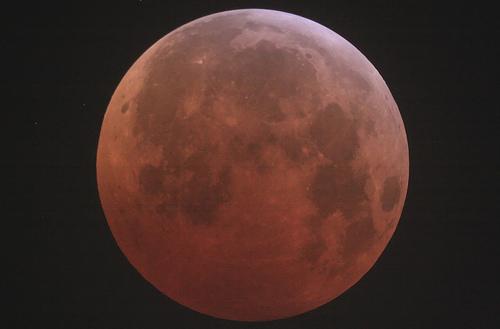
Pictures Of The 2010 Winter Solstice Lunar Eclipse

Bob Johnson from Blackholes and astrostuff took some great pictures of last night's lunar eclipse! Here they are for you to drool upon:

The beginnings of the darkest day in 372 years


Almost a total eclipse


Total lunar eclipse!


See also: 2010 Winter Solstice Lunar Eclipse Time Lapse Video